
Dinosaurs
Camarasaurus
Camarasaurus was a bulky sauropod with hollow chambers in its vertebrae, prompting Edward Drinker Cope to give it the name “Chambered Lizard.”
The first Camarasaurus ever found, a skeleton of Camarasaurus supremus, came from the Lucas quarries, and its bones were among the first fossils Oramel Lucas discovered. In life, Camarasaurus probably ate coarse plant material and traveled in family groups or herds. Its fore limbs were longer than its hind limbs, and each front foot had five toes with a large claw on the innermost one. Camarasaurus supremus is the largest known species of Camarasaur, reaching a length of 75 feet (23 meters) and possibly weighing as much as 51.8 tons, or 47 metric tonnes (Foster, 2007). With those measurements, one living Camarasaurus supremus would be over three times as long as a modern African elephant and weigh over eight times as much (CITES, 2011).
The Camarasaurus bones found in the Cope-Lucas Quarries were used to create the first full skeletal reconstruction of a sauropod. Cope hired the artist John A. Ryder draw out a life size skeletal reconstruction in 1877, and displayed the enormous illustration at The American Philosophical Society in Philadelphia later that year (Osborn and Mook, 1919; Jaffe, 2000). Cope was a supporter of museums and educating the public on paleontology, as opposed to Marsh who believed that fossils were only for the eyes of the scientists who studied them.
This Camarasaurus supremus reconstruction, Illustrated by John A. Ryder, was the first ever full skeletal reconstruction of a sauropod. The original 60-foot-long drawing was displayed at the American Philosophical Society in Philadelphia in 1877.
This more recent reconstruction of a Camarasaurus, created by Scott Hartman in 2011, shows how additional discoveries have refined what paleontologists think the sauropod looked like.
Camarasaurus supremus is the only dinosaur species Cope named from the Lucas quarries to still be considered completely valid today. Cope originally had also named a C. leptodirus from the quarries, but this was determined later to be another C. supremus (Osborn and Mook, 1921). Out of the twenty-six dinosaur genera Cope named in his career, Camarasaurus is one of the three that are still considered valid (Jaffe, 2000). Currently there are four species of Camarasaurus: C. supremus, C. grandis, C. lentus, and C. lewisi.
Out of all of the ancient animals found by the Lucases, this species has by far the most fossil material attributed to it. Later examinations of the bones and shipping records by Osborn and Mook (1921) and McIntosh (1998) have determined that there were between three to five individual Camarasaurs in the Cope-Lucas Quarries. Most of these Camarasaurus bones ended up in the American Museum of Natural History in New York, along with most of Cope's dinosaur collection. A few bones, however, were sold by Cope in 1891 to the Wagner Free Institute in Philadelphia, where they still reside today.
References
CITES fact sheet, Loxodonta africana, retrieved 2011.
Foster, J., 2007, Jurassic West: The Dinosaurs of the Morrison Formation and Their World, p. 201, 248.
Jaffe, M., 2000, The Guilded Dinosaur: The Fossil War Between E. D. Cope and the Rise of American Science: New York, Three Rivers Press, p. 424.
McIntosh, J. S., 1998, New information about the Cope collection of sauropods from Garden Park, Colorado: Modern Geology, v. 23, p. 481-506.
Osborn, H. F., and Mook, C. C., 1919, Characters and Restoration of the sauropod genus Camarasaurus Cope from type material in the Cope Collection in the American Museum of Natural History: Proceedings of the American Philosophical Society, v. 58, no. 6, p. 386-396.
Osborn, H. F., and Mook, C. C., 1921, Camarasaurus, Amphicoelias, and other sauropods of Cope: Memoirs of the American Museum of Natural History, New Series, v. 3, part 3, p. 247-387.
Apatosaurus
The bones now considered to belong to Apatosaurus were referred to by Cope as “Morosaurus laticollis” and by Osborn and Mook as Camarasaurussupremus. McIntosh in 1998 was the first researcher to refer to the Cope-Lucas fossils as an undetermined Apatosaurus species. The first Apatosaurus, A. ajax, was given its name by Marsh in 1877.
Apatosaurus is one of the three genera of sauropods found at the Cope-Lucas Quarries. It was similar to Diplodocus and Amphicoelias, though it was more robust than either. Apatosaurus grew around 78 feet long and weighed about 18 tons. It had proportionally tiny teeth, even for a sauropod, which it probably used to eat low growing plants, like ferns. Apatosaurus also had a very long whip-like tail like that of Diplodocus. Some scientists have suggested that Apatosaurus actually used its whip-tail as a weapon against predators and would have been able use it to produce an extremely loud cracking sound. (Carpenter, 1995)
One of the most famous examples of dinosaur naming confusion is the “Brontosaurus,” also named by Marsh. Paleontologists have since determined “Brontosaurus excelsus” to really be a large Apatosaurus, specifically A. excelsus. However, the name “Brontosaurus” was so widespread and so often mentioned in popular media that much of the public continued to use it long after it became an invalid name. Whether the two specimens are distinct enough to be considered seperate genera continues to this day and recent discoveries and research hope to clarify the debate. Bones of A. excelsus were found in the Marsh-Felch Quarry in Garden Park.
References
Carpenter, K., 1995, The Dinosaurs of Marsh and Cope: Cañon City, Colorado, Garden Park Paleontology Society, 22 p.

Size comparison of "Epanterias amplexus," the Allosaurus from the Cope-Lucas Quarries(brown silhouette), with specimens of Allosaurus fragilis and an average human. The animal found by the Lucases would have been much larger than any known A. fragilis.
Image by Scott Hartman, retrieved 2011.
Click the image above for more information about the image.
Camptosaurus
Camptosaurus belongs to a group herbivorous beaked dinosaur known as ornithopods. The location of the teeth in Camptosaurus’s skull suggests that it had fleshy cheeks. These would have helped keep food from spilling out as Camptosaurus chewed rough vegetation. Along with other ornithopods, Camptosaurus spent some of the time on its hind two legs, and some of the time on all four legs. Some scientists have proposed that Camptosaurus could run on its hind legs at speeds of up to 15 mph, or 25 km/h (Foster, 2007). A living Camptosaurus would have been about 18 feet long and weighed around 1500 lbs. Most ornithopods are thought to have traveled in herds, which would have protected them from predators like Allosaurus. (Carpenter, 1995)
Camptosaurus was originally named “Camptonotus” by Marsh in 1879, but was renamed in 1885 when Marsh realized that Camptonotus was already the name for a genus of cricket. Cope himself did not call any of the fossils in the Lucas quarries Camptosaurus, but fossils Cope named from the quarries as “Brachyrophus altarkansanus” and “Symphryophus musculosus” have both later been determined to be species of Camptosaurus. These fossils may have belonged to C. dispar, the largest species of Camptosaurus, but the small number of bones found makes specific identification difficult. (Carpenter, 1995)
References
Carpenter, K., 1995, The Dinosaurs of Marsh and Cope: Cañon City, Colorado, Garden Park Paleontology Society, p. 22.
Foster, J., 2007, Jurassic West: The Dinosaurs of the Morrison Formation and Their World: Bloomington, Indiana University Press, p. 389.
Stegosaurus
Stegosaurus, the state fossil of Colorado, was a strange looking herbivore with an array of distinctive plates along its back and spikes on its tail. Its name, which means “roof lizard,” comes from an early theory that Stegosaurus’s plates laid flat on its back, overlapping each other like shingles on a roof. Today, most paleontologists think of Stegosaurus’s plates as sticking straight up out of the back in two alternating rows. The discovery of the world’s most complete Stegosaurus in 1992 supported this theory, as its plates appear to be in two alternating rows.
As with Camptosaurus, Apatosaurus, and Allosaurus material in this location, the Stegosaurus fossils in the Cope-Lucas Quarries were originally given different names. Bones from what Cope called “Hypsirhophus discurus” and “H. seeleyanus” were probably remains of Stegosaurus. The previously mentioned 1992 Stegosaurus, also found in Garden Park, is a specimen of S. stenops, which in life would have been about 23 feet long (7 meters). (Carpenter, 1998)
This image, created by Matt Martyniuk, shows Stegosaurus stenops, the type species identified by Marsh in 1887, and S. ungulatus,
also named by Marsh in 1879.
Reference
Carpenter, K., 1998, Armor of Stegosaurus stenops, and the taphonomic history of a new specimen from Garden Park Colorado in The Upper Jurassic Morrison Formation: An Interdisciplinary Study, Part 1: Modern Geology, no. 22. p. 127–144.
Amphicoelias
Amphicoelias is a genus of giant sauropod that possibly includes the largest land animal ever found. While it was enormous, Amphicoelias was also very slender, its build slighter than that of the bulkier and much more common Camarasaurus. Amphicoelias was an herbivore, though it probably didn’t eat as coarse of material as Camarasaurus did.
Garden Park is the type locality for all three of the Amphicoelias species Cope named: Amphicoelias altus, A. latus, and A. fragillimus. The type specimen of A. altus was known as “A. Ripley’s Fossil” and was probably found by Aaron Ripley, the husband of Oramel and Ira Lucas’s sister Lucy. According to Cope’s notes, one A. latus femur ended up at Oberlin College. Oramel Lucas had probably brought it back with him to school in 1878. The fossil appears to have since been lost, however, as recent attempts to locate it at Oberlin have failed (McIntosh, 1998). Osborn and Mook (1921), along with every subsequent researcher of Amphicoelias, considered A. altus and A. latus to be the same species. A living Amphicoelias altus would have been around 98 feet long, but was so slender it would have "only" weighed about 30 tons or roughly 27 metric tons(Carpenter, 1995). Amphicoelias fragillimus, however, was much larger.
Size comparison between Amphicoelias altus (green), A. fragillimus (orange), and an average human (blue). Image by Matt Martyniuk, retrieved 2011.
Amphicoelias fragillimus is only known from one enormous fragmented vertebra (about 4.9 feet, or 1.5 meters tall) (Cope, 1878), which has been lost. If complete, the vertebra would probably have been well over 8 feet tall (2.7 meters). Carpenter (2006) estimated the length of A. fragillimus at 190 feet long (about 58 meters), which is within the range suggested by Paul (1994) of 40-60 meters or 131-196 feet . Even conservative estimates of 130 feet (40 meters) would still make A. fragilimus by far the longest animal ever found. While weight is even more difficult to estimate, Carpenter (2006) calculated that A. fragillimus could have weighed up to 130 tons (118 metric tons). This would make Amphicoelias fragillimus heavier than any other known dinosaur, with the possible exception of Bruhathkayosaurus, another sauropod whose fragmentary remains have not yet been properly described.
Size comparison between five of the longest dinosaurs estimated, with an average human in the lower left for scale. Amphicoelias fragillimus (red) is shown here estimated at a length of 190 feet (58 meters), clearly dwarfing every other sauropod. Image by Matt Martyniuk, retrieved 2011.
The gigantic size and disappearance of the A. fragillimus bones have caused many to believe the entire thing was a hoax. Some arguments point to the find being real, however. For example, Marsh never seemed to question the gigantic Amphicoelias bone, and Marsh was a ferocious and meticulous critic of Cope’s (Carpenter, 2006). Osborn and Mook (1921) did not seem to question that the giant vertebra existed at some point, even if it is lost now.
Others argue that A. fragilimus existed but Cope's sketch had typographical errors. Cope was known to rush his work to publish as many papers as quickly as possible and even misspelt "fragillimus" in his publication. Careful examination of the sketch by Woodruff and Foster (2015) revealed that the various dimensions were not proportional. Had Cope mistakenly written "1500" milimeters instead of "1050", the total length of the bone would have matched the scale of the width and diameter Cope noted. This new figure would still make A. fragillimus one of the largest sauropods ever found but it would not be nearly double the size of any dinosaur that has been found. Woddruff and Foster also raised the question that if the specimen was that large, why didn't the American Museum of Natural History show any interest in displaying the largest dinosaur ever discovered, and why did Cope never mention the fossil again? It is possible that Cope's errors were accepted by his collegues and it wasn't until years after his death that someone interpreted the sketch as 1,500 milimeters.
Scientists in Cope’s time were amazed at the size of sauropods, even without counting the gigantic A. fragillimus. Many people, including Cope, thought that they were far too large to support their weight on land and therefore must have spent the majority of their time in the water. Today most paleontologists believe sauropods to be primarily land animals.
Osborn and Mook (1921) and McIntosh (1998) considered A. fragillimus to be simply a large A. altus, but Carpenter (2006) argued that from Cope’s descriptions it was different enough to be its own species. Confirmation of whether they are the same species or not is almost impossible without the actual bones of A. fragillimus to examine.
Noting many similarities between them, Foster (2007) and others have suggested that Amphicoelias and Diplodocus belong to the same genus. If further research supports this, the name Diplodocus would have to be abandoned for Amphicoelias, as that name was published first. Osborn and Mook (1921) also noted the similarities between Amphiceolias and Diplodocus, though they kept them as separate genera.
Drawing by E. D. Cope of a herd of semi-aquatic Amphicoelias.
Most paleontologists today think of sauropods as land animals
and would consider this reconstructed scene unlikely.
References
Carpenter, K., 1995, The Dinosaurs of Marsh and Cope: Cañon City, Colorado, Garden Park Paleontology Society, p. 22.
Carpenter, K., 2006, Biggest of the big: a critical re-evaluation of the mega-sauropod Amphicoelias fragillimus, in Foster, J. R., and Lucas, S. G., eds., Paleontology and Geology of the Upper Jurassic Morrison Formation: New Mexico Museum of Natural History and Science Bulletin, no. 36, p. 131-138.
Cope, E. D.,1878, A new species of Amphicoelias: American Naturalist, v. 12, no. 8, p. 563-564.
Foster, J., 2007, Jurassic West: The Dinosaurs of the Morrison Formation and Their World: Bloomington, Indiana University Press, 389 p.
McIntosh, J. S., 1998, New information about the Cope collection of sauropods from Garden Park, Colorado: Modern Geology, v. 23, p. 481-506.
Osborn, H. F., and Mook, C. C., 1921, Camarasaurus, Amphicoelias, and other sauropods of Cope: Memoirs of the American Museum of Natural History, New Series, v. 3, Part 3, p. 247-387.
Paul, G. S., 1994, Big sauropods - really, really big sauropods: The Dinosaur Report, The Dinosaur Society, Fall, p. 12-13.
Woodruff C, Foster JR. (2015) The fragile legacy of Amphicoelias fragillimus (Dinosauria: Sauropoda; Morrison Formation - Latest Jurassic)
Nanosaurus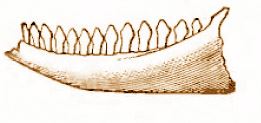
Nanosaurus is a poorly known genus of ornithopod, a group of plant eating dinosaurs that includes Camptosaurus. The species found in the Lucas quarries, currently the only valid species of the genus, is N. agilis. The partial skeleton of Nanosaurus agilis, found by Lucas in Garden Park, is the only specimen of this species, and consists of a jawbone, part of a pelvis, and a few limb bones. Due to the fragmentary nature of its remains, most reconstructions of Nanosaurus are based on the closely related Othnelia, which was named for Marsh and was also present in Garden Park. Carpenter (1995), using the related English dinosaur Hypsilophodon as a model, estimated that a living Nanosaurus would be about 2 feet long and weigh roughly 5 pounds. Oramel Lucas actually sent the specimen of Nanosaurus agilis to Marsh instead of Cope, after being convinced to do so by Marsh’s employee Mudge (Jaffe, 2000). Nanosaurus agilis ended up being the first dinosaur that Marsh named from Garden Park (Carpenter, 1995).
References
Carpenter, K., 1995, The Dinosaurs of Marsh and Cope: Cañon City, Colorado, Garden Park Paleontology Society, p. 22.
Jaffe, M., 2000, The Gilded Dinosaur: The Fossil War Between E. D. Cope and O. C. Marsh and the Rise of American Science: New York, Three Rivers Press, p. 424.
Marsh, O. C., 1896, The Dinosaurs of North America: U. S. Geological Survey: Sixteenth Annual Report, 1894-1895, p. 133-414.